📝 Chapter 2: Assurance of Learning Exercises
LO 2-1 LO 2-2 LO 2-3 LO 2-4 LO 2-5 Questions 1–4 + Simulation Exercises 1–5 | Pages 46–47
Textbook: Thompson, Peteraf, Gamble & Strickland — Crafting & Executing Strategy: The Quest for Competitive Advantage, 24th Edition (McGraw Hill, 2024)
Chapter: Chapter 2 — "Charting a Company's Direction: Its Vision, Mission, Objectives, and Strategy"
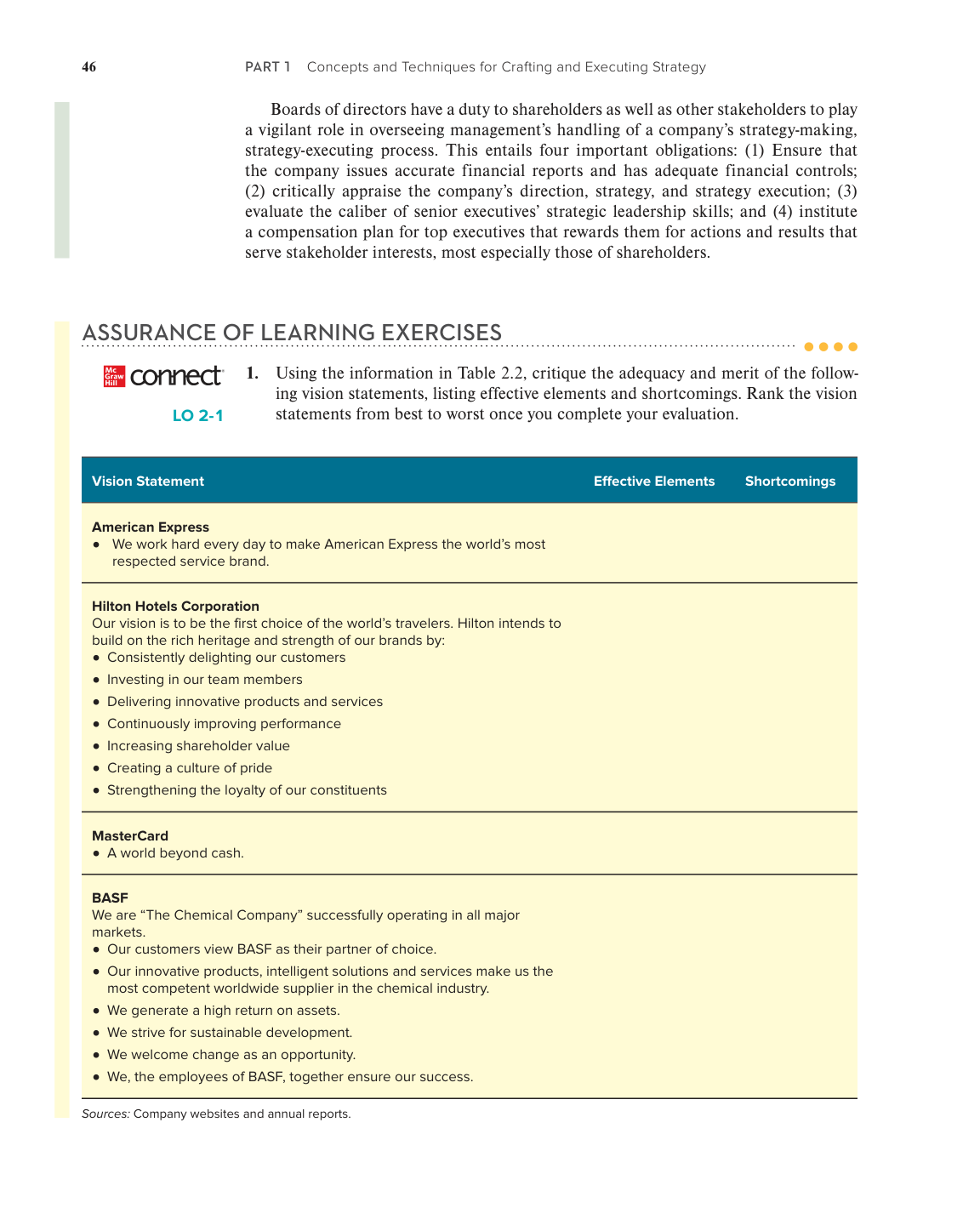
📸 Textbook Page 46 — Original Assurance of Learning Exercises (Vision Statement Ranking). Right-click → Open Image in New Tab to zoom.
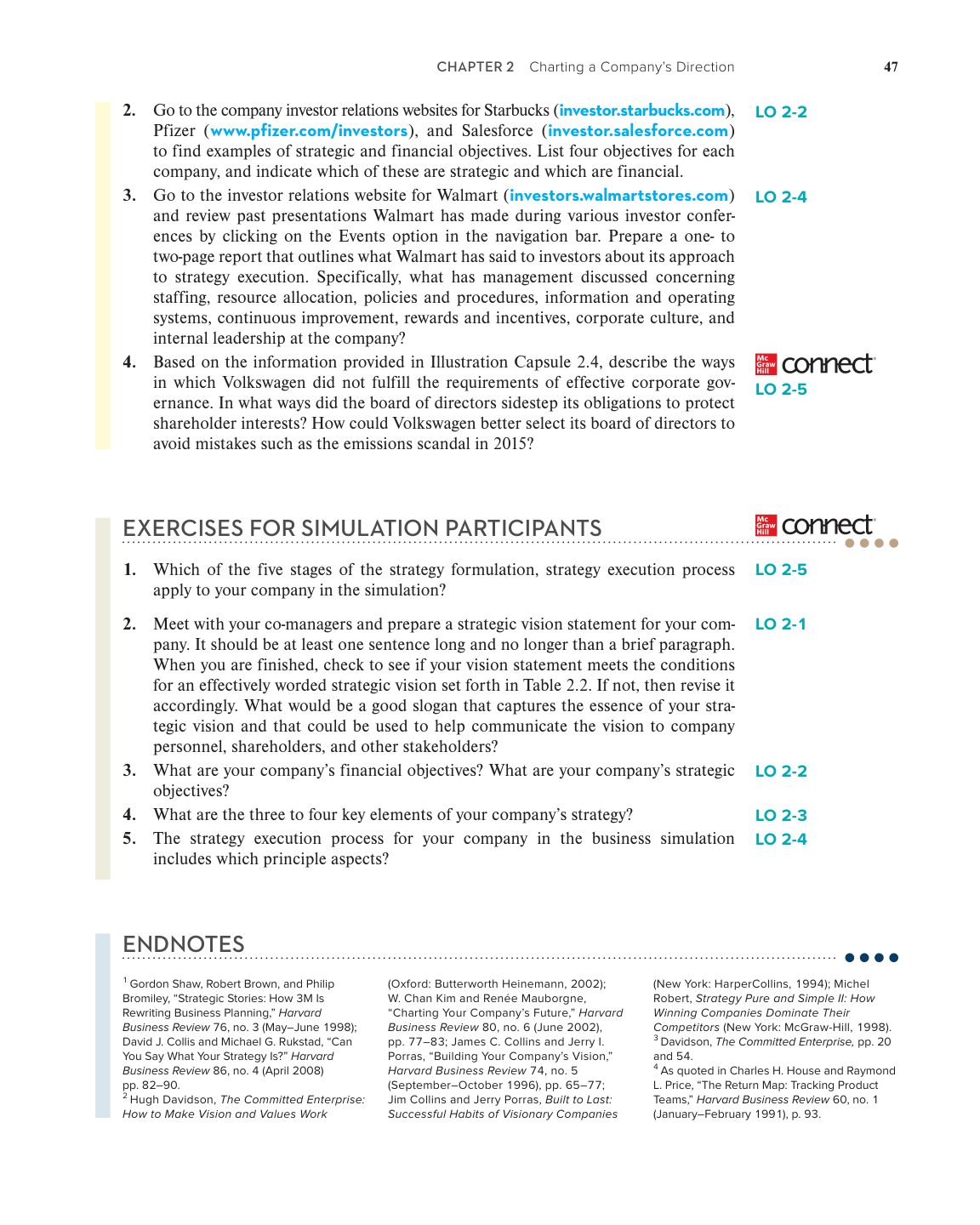
📸 Textbook Page 47 — Questions 2–4 + Simulation Exercises 1–5. Right-click → Open Image in New Tab to zoom.
📋 Table 2.2 — Characteristics of Effective Vision Statements
This is the scoring rubric for Question 1. Use these seven criteria to evaluate each vision statement.
| # | Criterion | What It Means | Question to Ask |
|---|---|---|---|
| 1 | Graphic | Paints a clear picture of the kind of company management is trying to create and the market position being staked out | Can I visualize what this company will look like in the future? |
| 2 | Directional | Forward-looking; describes the strategic course management has charted | Does it tell me where the company is headed? |
| 3 | Focused | Specific enough to provide managers with guidance in making decisions and allocating resources | Would this help a manager decide what to prioritize? |
| 4 | Flexible | Not a once-and-for-all-time statement; can be adjusted as circumstances change | Could the company pivot without abandoning this vision? |
| 5 | Feasible | Within the realm of what the company can reasonably expect to achieve | Is this actually achievable with the company's resources? |
| 6 | Desirable | Indicates why the directional path makes good business sense — there's a compelling rationale | Do stakeholders have a reason to get behind this? |
| 7 | Easy to Communicate | Can be explained clearly and compellingly in 5–10 minutes; ideally reducible to a memorable slogan | Can an employee explain this to a stranger in under a minute? |
📖 Textbook Reference: Chapter 2, Table 2.2 — "Characteristics of Effectively Worded Vision Statements." The textbook emphasizes that the best vision statements are clear, crisp, and compelling — they avoid jargon, buzzwords, and vague aspirations.
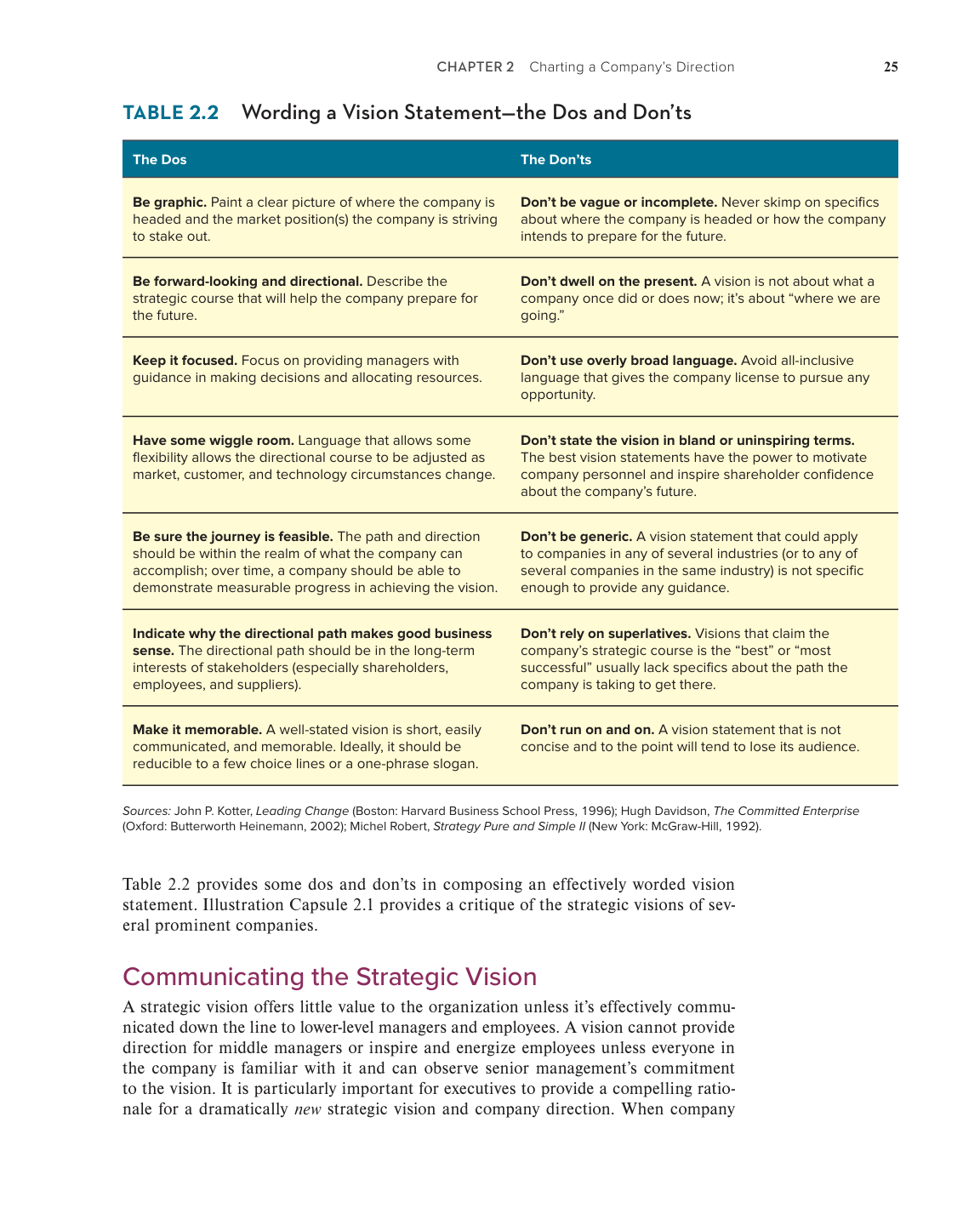
📸 Table 2.2 — Original textbook reference. Right-click → Open Image in New Tab to zoom.
LO 2-1 · Question 1
Using the information in Table 2.2, critique the adequacy and merit of the following vision statements, listing effective elements and shortcomings. Rank the vision statements from best to worst once you complete your evaluation.
American Express — "We work hard every day to make American Express the world's most respected service brand."
Evaluation — Score: 3/7
| Criterion | ✓/✗ | Analysis |
|---|---|---|
| Graphic | ✗ | Too vague — "most respected service brand" does not paint a picture of what the company looks like. What specific market position is being staked out? |
| Directional | ✓ | Forward-looking — "make American Express" implies a journey toward an aspirational state. The direction is toward respect and service excellence. |
| Focused | ✗ | Lacks specificity — does not guide resource allocation decisions. What products? Which markets? What customers? |
| Flexible | ✓ | Broad enough to accommodate changing product lines and market conditions while staying true to the service-brand identity. |
| Feasible | ✓ | AmEx already has a respected brand; the vision is aspirational but grounded. Achievable with sustained investment in customer experience. |
| Desirable | ~ | Does "most respected" translate to business outcomes? The link between brand respect and stakeholder value is implied but not articulated. |
| Easy to Communicate | ✗ | The statement is short but not memorable. It sounds like corporate boilerplate — lacks emotional resonance or a distinctive hook. |
Effective Elements: Directional (aspirational journey), feasible (builds on existing strength), appropriately broad for a diversified financial services firm.
Shortcomings: Not graphic — can't visualize the end state. Not focused — no guidance for strategic decisions. Generic wording ("work hard every day," "most respected") could apply to almost any company.
Verdict: A mediocre vision statement. It signals aspiration but fails the textbook's core tests of being graphic, focused, and easy to communicate. As Thompson et al. argue, a vision statement should be "distinctive and specific to a particular organization" — this one is not.
Hilton Hotels Corporation — "Our vision is to be the first choice of the world's travelers. Hilton intends to build on the rich heritage and strength of our brands by: consistently delighting our customers, investing in our team members, delivering innovative products and services, continuously improving performance, increasing shareholder value, creating a culture of pride, strengthening the loyalty of our constituents."
Evaluation — Score: 5/7
| Criterion | ✓/✗ | Analysis |
|---|---|---|
| Graphic | ✓ | "First choice of the world's travelers" paints a vivid picture — Hilton properties as the default, go-to hospitality brand globally. You can visualize a traveler instinctively choosing Hilton. |
| Directional | ✓ | Clear forward trajectory — "to be" signals aspiration. The direction is toward market leadership in global hospitality. |
| Focused | ✓ | The seven supporting pillars enumerate how the vision will be achieved — delighting customers, investing in team, innovating, etc. These pillars give managers actionable guidance. |
| Flexible | ✓ | The pillars accommodate shifts in execution while maintaining the core vision. Hilton could change its product mix or technology platform without rewriting the vision. |
| Feasible | ✓ | Hilton already has global scale and brand strength. Becoming "first choice" is a stretch goal — ambitious but not delusional given current market position. |
| Desirable | ✓ | Multiple stakeholders addressed — customers (pillar 1), team members (pillar 2), shareholders (pillar 5), and broader constituents (pillar 7). The "why" is clear. |
| Easy to Communicate | ✗ | The opening sentence is strong ("first choice of the world's travelers") but the seven-bullet amplification makes it too long. The memorable core is diluted by the corporate-speak list. |
Effective Elements: The headline "first choice of the world's travelers" is graphic, directional, and memorable. The seven pillars make the vision substantive by spelling out HOW. Multiple stakeholder groups are acknowledged, demonstrating the vision's breadth.
Shortcomings: Too long — the textbook says a vision should be communicable in 5–10 minutes, but seven distinct bullet points with corporate language (e.g., "continuously improving performance") make it feel like an internal strategy document rather than an inspiring vision. Some bullets are generic (every company "continuously improves").
Verdict: A strong vision statement. The core phrase is excellent; the amplification, while helpful for internal guidance, reduces memorability. Hilton would benefit from leading with the slogan and keeping the seven pillars as internal supporting material.
MasterCard — "A world beyond cash."
Evaluation — Score: 6/7
| Criterion | ✓/✗ | Analysis |
|---|---|---|
| Graphic | ✓ | Tremendously effective — you instantly visualize a world where physical currency is obsolete and every transaction is digital. The image is simultaneously aspirational and concrete. |
| Directional | ✓ | Unequivocally forward-looking. MasterCard is charting a course toward a specific future state where the entire payments ecosystem has transformed. |
| Focused | ~ | Partly focused — it draws a clear boundary (payments/digital transactions) but is silent on MasterCard's specific role. Is MasterCard the technology provider? The network? The ecosystem orchestrator? The vision is so broad it could also describe Visa, PayPal, or even a cryptocurrency. |
| Flexible | ✓ | Extremely flexible — "a world beyond cash" accommodates mobile payments, blockchain, biometric authentication, or any future payment technology. The vision never becomes obsolete. |
| Feasible | ✓ | Trending toward feasibility — cash usage is declining globally. MasterCard has the infrastructure and partnerships to make this a reality. The vision is ambitious but not fantastical. |
| Desirable | ✓ | Compelling for multiple stakeholders — consumers (convenience), merchants (reduced cash-handling costs), governments (tax compliance, reduced fraud). The business case is inherent in the vision. |
| Easy to Communicate | ✓ | Exemplary — four words. Anyone in the organization can remember it. It fits on a business card. It works in any language. This is the textbook's ideal: "reducible to a memorable slogan." |
Effective Elements: Extraordinary brevity and memorability (4 words). Vividly graphic — paints an unmistakable picture. Directional and aspirational while remaining timeless (cashless societies may still be 50 years away in some regions). The simplicity is its power — every employee, partner, and customer can internalize it.
Shortcomings: The focus is slightly too broad — it doesn't distinguish MasterCard from any other digital payments provider. A competitor could adopt the same vision verbatim. The "how" is entirely absent — managers get zero guidance on resource allocation or strategic priorities.
Verdict: An excellent vision statement — arguably the strongest of the four. The textbook emphasizes that "brevity is a virtue" in vision statements, and MasterCard's four-word vision is the gold standard for communicability and memorability. The lack of company-specificity is the only meaningful weakness.
BASF — "We are 'The Chemical Company' successfully operating in all major markets. Our customers view BASF as their partner of choice. Our innovative products, intelligent solutions and services make us the most competent worldwide supplier in the chemical industry. We generate a high return on assets. We strive for sustainable development. We welcome change as an opportunity. We, the employees of BASF, together ensure our success."
Evaluation — Score: 4/7
| Criterion | ✓/✗ | Analysis |
|---|---|---|
| Graphic | ~ | The self-description as "The Chemical Company" attempts to paint a picture of industry-defining leadership, but the amplification sentences drift into generic corporate language that is not visual. |
| Directional | ✗ | Uses present tense — "We are," "our customers view," "we generate." This describes current reality rather than an aspirational future. The statement reads more like a mission statement than a vision. |
| Focused | ✓ | Reasonably focused — anchored in the chemical industry, with specific claims about customer partnership, innovation, and financial performance. The "Chemical Company" self-designation is bold and distinctive. |
| Flexible | ✓ | Accommodates technology shifts and product portfolio changes within the broad chemical industry umbrella. |
| Feasible | ✓ | BASF IS the world's largest chemical company — "The Chemical Company" is a statement of fact as much as aspiration. Realistic given current market position. |
| Desirable | ✗ | Weak — "high return on assets" is a financial objective, not a compelling reason for stakeholders to rally behind the vision. The statement addresses multiple audiences but fails to articulate WHY any of them should care. |
| Easy to Communicate | ✗ | Seven sentences of corporate prose. Not memorable. The core "The Chemical Company" is strong but gets buried in verbose elaboration. No employee could recite this. |
Effective Elements: "The Chemical Company" is a bold, distinctive self-designation that claims category leadership. Reasonably focused within the chemical industry. Factually grounded — BASF has the scale to back up the claim.
Shortcomings: Critical failure — reads as a mission statement (present-tense description), not a vision (future-oriented aspiration). The textbook clearly distinguishes between mission ("who we are, what we do") and vision ("where we are going"). Too long and corporate (seven sentences!). The financial objective ("high return on assets") belongs in the strategic objectives section, not the vision statement.
Verdict: A misaligned statement. The core concept ("The Chemical Company") has potential, but BASF confused vision with mission and diluted the powerful self-designation with corporate filler. If trimmed to "To be The Chemical Company" with one supporting sentence, it would score significantly higher.
🏆 Final Ranking (Best → Worst)
| Rank | Company | Score | Summary Verdict |
|---|---|---|---|
| 1 | MasterCard | 6/7 | The textbook ideal: graphic, memorable, directional, and breathtakingly brief. Four words that every stakeholder can internalize. Loses one point for lacking company-specificity — Visa could steal it. |
| 2 | Hilton Hotels | 5/7 | The strongest headline — "first choice of the world's travelers" is graphic and directional. Seven pillars add substance but reduce memorability. A tighter version could challenge MasterCard. |
| 3 | BASF | 4/7 | Bold self-designation undermined by present-tense framing (reads as mission, not vision) and excessive corporate verbiage. "The Chemical Company" is a great seed that needs a future-oriented rewrite. |
| 4 | American Express | 3/7 | Generic and uninspiring. "Most respected service brand" could describe FedEx, Ritz-Carlton, or any service company. Fails to be graphic, focused, or distinctive — the textbook's core requirements. |
📖 Textbook Reference: Chapter 2, pp. 36–46. The textbook's examples of effective visions (e.g., "to make people happy" — Walt Disney's original vision for Disneyland) repeatedly emphasize brevity, emotional resonance, and distinctiveness — criteria against which MasterCard excels and American Express falls short.
LO 2-2, 2-4, 2-5 · Questions 2–4
Research-based exercises using investor relations websites.
(Q2) LO 2-2 — Starbucks, Pfizer, and Salesforce: Characteristics of Their Strategic Visions
Textbook Framework: Chapter 2 defines a strategic vision as "management's view of the company's long-term direction — what it is trying to become." Key elements include: (1) market position being staked out, (2) products/services offered, (3) customers served, and (4) capabilities to be developed.
| Company | Vision / Direction Statement | Key Characteristics |
|---|---|---|
| ☕ Starbucks | "To inspire and nurture the human spirit — one person, one cup, and one neighborhood at a time." | Graphic — evokes warmth and human connection. Focused on community ("neighborhood"). Flexible — technology and products can evolve. Not industry-specific — could describe a non-profit. |
| 💊 Pfizer | "Breakthroughs that change patients' lives." | Exceptionally brief and memorable (5 words). Directional — research-focused, patient-centered. Focused on innovation (R&D pipeline). Desirable — healthcare impact connects to deep human values. |
| ☁️ Salesforce | "We bring companies and customers together." | Graphic — connectivity metaphor. Flexible — accommodates any CRM technology. Broad — could describe any enterprise software company. The brevity mirrors MasterCard's approach. |
Common Pattern: All three companies prioritize brevity (5–15 words) over comprehensiveness. This aligns with the textbook's guidance that "overly long, thoroughly descriptive vision statements tend to fall on deaf ears." None enumerate specific products, financial targets, or detailed strategies — those belong in the strategic plan, not the vision statement.
How to answer for your assignment: Visit each company's investor relations website, locate their vision/mission statement, and evaluate it against Table 2.2. Note whether they separate vision (future-oriented) from mission (present-oriented) — the textbook emphasizes this distinction. Contrast their public-facing vision with their internal strategic plan documents (often found in annual reports or investor presentations).
📖 Textbook Reference: Chapter 2, pp. 36–41 — "Developing a Strategic Vision." The textbook uses Keurig Dr Pepper's strategic vision as an extended example, showing how a vision should be "distinctive and specific."
(Q3) LO 2-4 — Walmart: Approach to Strategy Execution
Textbook Framework: Chapter 2 introduces strategy execution within the 5-phase strategy process (Phase 4: "Implementing and Executing the Strategy"). The textbook emphasizes that execution is "operations-driven" — focused on people, processes, and organizational capabilities.
Walmart's Execution Approach (from investor relations):
- People-led, tech-powered: Walmart frames execution as combining frontline associate investment (wages, training, career pathways) with technology (AI-driven supply chain, automated fulfillment centers, app-based inventory management).
- Everyday Low Price (EDLP) as an operating discipline: EDLP is not just a marketing slogan — it's an execution philosophy requiring relentless cost control, efficient logistics, and supplier partnership throughout the value chain.
- Omnichannel integration: Execution priority is seamless integration of physical stores, e-commerce, pickup, and delivery — what Walmart calls "serving customers however they want to shop."
- Sustainability and stakeholder capitalism: Execution extends to supply chain sustainability (Project Gigaton), associate advancement, and community investment — aligning with the textbook's discussion of CSR in strategy execution.
Textbook Connection: Walmart's approach illustrates the book's core argument that strategy execution requires aligning organizational structure, staffing, policies, and reward systems with the strategy. EDLP is not achievable without the execution backbone of efficient logistics and cost discipline. This is precisely why Chapter 2 emphasizes that Board oversight must include evaluating "the caliber of senior executives' strategic leadership skills" — because execution is where strategy succeeds or fails.
📖 Textbook Reference: Chapter 2, Phase 4 discussion — "Implementing and Executing the Strategy." Also see the Board's oversight duties (Role 2: "Evaluate the caliber of senior executives' strategic leadership").
(Q4) LO 2-5 — Volkswagen: Corporate Governance and the Emissions Scandal (Illustration Capsule 2.4)
Context: In 2015, Volkswagen was caught installing "defeat devices" in 11 million diesel vehicles worldwide — software that detected emissions testing and temporarily reduced emissions, while on the road the vehicles emitted up to 40× the legal limit of nitrogen oxides. The scandal cost VW over €30 billion in fines, settlements, and recalls.
Governance Failures (from the textbook):
| Governance Failure | Explanation | Textbook Link |
|---|---|---|
| 1. Weak Board Oversight | VW's supervisory board was dominated by the Porsche-Piëch family and labor representatives, with limited independent directors. The board failed its duty to "critically appraise the company's direction, strategy, and business approaches." | Board Role 1: "Critically appraise the strategy" |
| 2. Toxic "Success at Any Cost" Culture | CEO Martin Winterkorn's authoritarian leadership created fear of failure. Engineers faced impossible emissions targets. The organizational culture incentivized cheating rather than admitting technological limitations. | Board Role 2: "Evaluate the caliber of senior executives' strategic leadership" |
| 3. Misaligned Incentives | Executive compensation was tied to aggressive growth targets (becoming the world's #1 automaker by 2018) without adequate compliance or ethics metrics. The Board failed to "institute a compensation plan that rewards actions and results that serve stakeholder interests." | Board Role 3: Align compensation with stakeholder interests |
| 4. Inadequate Controls | VW lacked the internal reporting and control mechanisms to detect the fraud early. Whistleblower channels were ineffective. The Board failed to "ensure accurate financial reporting and adequate controls." | Board Role 4: Ensure accurate reporting and controls |
| 5. Dual-Class Share Structure | The Porsche-Piëch family controlled over 50% of voting rights, insulating management from shareholder accountability. This concentrated power structure enabled the governance failures. | Ch. 2: "In many companies, board members are not truly independent" |
Key Takeaway: The VW scandal is a textbook case of what happens when ALL FOUR board duties fail simultaneously. Thompson et al. argue that "a strong, independent board of directors is essential to good corporate governance" — VW demonstrated the catastrophic consequences of weak governance. The scandal also validates the textbook's emphasis on ethics and CSR (Chapter 9) as integral to strategy, not afterthoughts.
Lessons for Your Company:
- Ensure independent board members with relevant expertise (engineering, compliance, finance)
- Tie executive compensation to ethical performance metrics, not just growth targets
- Build a culture where admitting problems is rewarded, not punished
- Implement robust whistleblower protections and internal audit functions
- Separate CEO and board chair roles to prevent concentration of power
📖 Textbook Reference: Illustration Capsule 2.4 — "Volkswagen's Governance Failure and Emissions Scandal." Also see Chapter 2 section on "Corporate Governance: The Role of the Board of Directors" and the Board's four specific oversight duties.
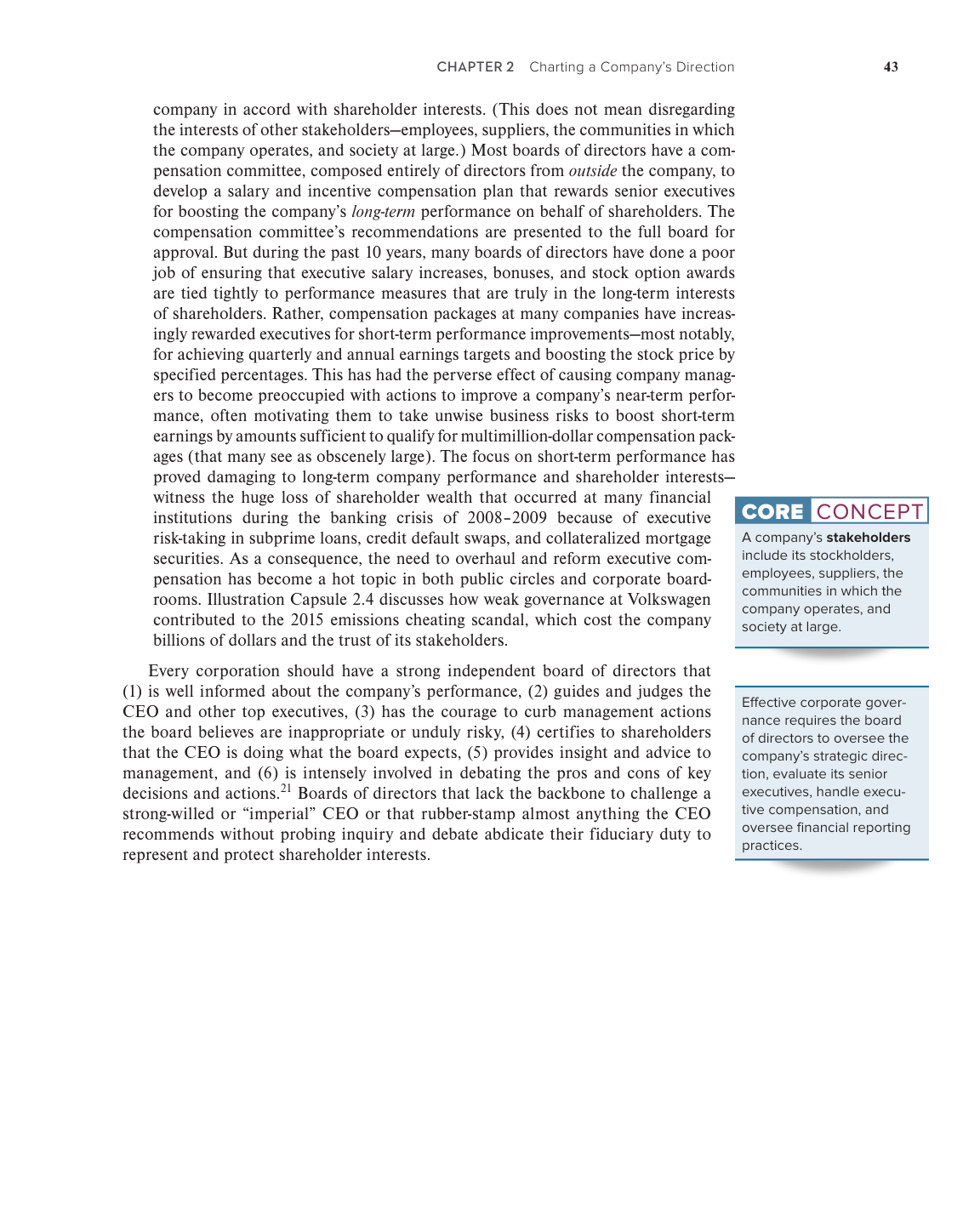
📸 Illustration Capsule 2.4 — Original textbook case study on VW's governance collapse. Right-click → Open Image in New Tab to zoom.
🎮 Exercises for Simulation Participants (1–5)
These exercises apply Chapter 2 concepts to a simulated company. Adapt the model answers to your simulation's specific industry and competitive context.
Exercise 1 (LO 2-5) — Five Stages of Strategy Formulation
Textbook Framework — The 5-Phase Strategy Process (Chapter 2):
| Phase | Key Question | Activity | Example for a Simulated Company |
|---|---|---|---|
| 1. Develop Vision, Mission, Values | "Where are we going?" | Define long-term direction, core purpose, and guiding principles | Craft a vision like "To be the premium athletic footwear brand for urban professionals" |
| 2. Set Objectives | "What must we achieve?" | Financial (ROE, revenue, margins) + Strategic (market share, innovation, brand) | Financial: 15% ROE, 20% annual revenue growth. Strategic: 5% market share by Year 3 |
| 3. Craft Strategy | "How will we get there?" | Competitive moves, business approaches, resource allocation | Broad Differentiation strategy — premium materials, celebrity endorsements, DTC e-commerce |
| 4. Implement & Execute | "How do we make it happen?" | People, processes, structure, culture, policies — operations-oriented | Hire design talent, build supply chain, launch marketing campaign, staff customer service |
| 5. Evaluate & Adjust | "Is it working? What needs to change?" | Monitor performance, identify corrective actions, revise based on results | Quarterly reviews: if social media sales underperform, shift budget to influencer marketing |
📖 Textbook Reference: Chapter 2, pp. 29–35 — "The Strategy-Making, Strategy-Executing Process." The process is continuous and iterative — Phase 5 feeds back into all preceding phases.
Exercise 2 (LO 2-1) — Prepare a Strategic Vision Statement
Template for crafting a vision statement (based on Table 2.2):
- Identify the market position: What space will your company occupy? (e.g., "To become the leading provider of affordable, sustainable home energy solutions in Southeast Asia")
- Define the customer impact: What difference will you make for customers? (e.g., "enabling every household to generate and store their own clean energy")
- Make it aspirational but feasible: Stretch targets that motivate without being absurd (e.g., "To power 10 million homes with renewable energy by 2035")
- Test against the 7 criteria: Run your draft through Table 2.2 — is it graphic? Directional? Focused? Flexible? Feasible? Desirable? Easy to communicate?
- Distill to a slogan: Can you reduce it to 5–10 memorable words? MasterCard's "A world beyond cash" is the benchmark.
"A strategic vision describes management's aspirations for the company's future and provides a panoramic view of 'where we are going.'" — Chapter 2
📖 Textbook Reference: Chapter 2, pp. 36–41 — "Developing a Strategic Vision."
Exercise 3 (LO 2-2) — Financial Objectives
Textbook Framework: Chapter 2 distinguishes between financial objectives (outcomes that improve financial performance — revenue growth, profitability, ROE, cash flow) and strategic objectives (outcomes that strengthen competitive position — market share, product quality, innovation, brand recognition).
| Financial Objective | Target (Example) | Why This Matters |
|---|---|---|
| Revenue Growth | 20% CAGR for 5 years | Captures market share; signals viability to investors |
| Return on Equity (ROE) | 18% by Year 3 | Indicates efficient use of shareholder capital; the textbook's preferred financial metric |
| Gross Margin | 45%+ | Demonstrates pricing power and cost efficiency |
| Operating Cash Flow | Positive by Year 2 | Ensures company can fund its own growth without constant external financing |
| Earnings per Share (EPS) | $2.50 by Year 5 | Directly linked to shareholder value |
The Balanced Scorecard Approach: Thompson et al. recommend using a Balanced Scorecard that includes both financial AND strategic objectives. Don't just set revenue targets — also set objectives for customer satisfaction, internal process quality, and organizational learning. This prevents the "tyranny of financial metrics" that can lead to short-term thinking.
📖 Textbook Reference: Chapter 2, pp. 41–46 — "Setting Objectives." Also see the Balanced Scorecard discussion.
Exercise 4 (LO 2-3) — Key Elements of Strategy
Textbook Framework: A company's strategy consists of the competitive moves and business approaches management employs. Chapter 2 identifies these key elements:
| Strategic Element | Question It Answers | Example Decision |
|---|---|---|
| Competitive Approach | How will we compete? | Broad Differentiation — premium products with unique R&D |
| Product Line Breadth | What products/services? | 3 core product categories; annual new product introduction |
| Market Scope | Which markets/customers? | North America Year 1; EU Year 3; Asia-Pacific Year 5 |
| Value Chain Configuration | Make or buy? | In-house design + outsourced manufacturing; DTC e-commerce + select retail partners |
| Technology & Innovation | How to stay ahead? | 5% of revenue to R&D; 2 patents/year target; AI-driven customer insights |
| Strategic Partnerships | Who do we ally with? | Supplier exclusivity agreements; celebrity brand ambassador partnerships |
| Organization & Culture | How do we operate? | Flat hierarchy, agile teams, innovation-focused culture, ESG compliance |
These elements collectively form the Strategy-Making Hierarchy (Figure 2.2): Corporate Strategy → Business Strategy → Functional Area Strategies → Operating Strategies. At each level, these seven elements are adapted to the scope of that level.
📖 Textbook Reference: Chapter 2, pp. 46–50 — "Crafting a Strategy." Also see Figure 2.2: "A Company's Strategy-Making Hierarchy."
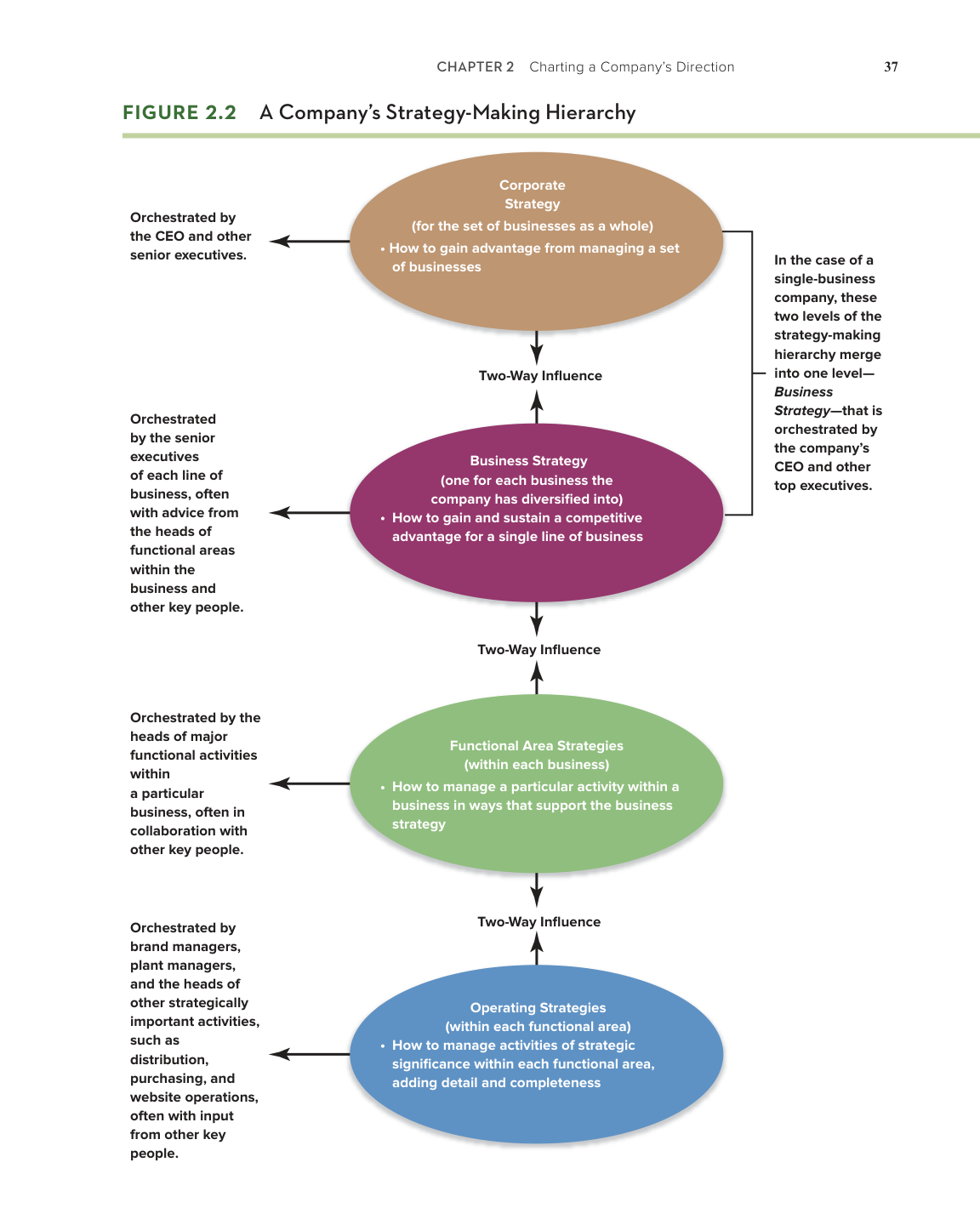
📸 Figure 2.2 — Original textbook diagram. Corporate → Business → Functional → Operating levels with two-way influence arrows. Right-click → Open Image in New Tab to zoom.
Exercise 5 (LO 2-4) — Strategy Execution Process
Textbook Framework: Strategy execution is Phase 4 of the 5-phase process. The textbook emphasizes that "executing strategy is primarily an operations-driven activity revolving around management of people and business processes."
| Execution Component | Key Actions | Example for Simulated Company |
|---|---|---|
| 1. Build the Organization | Staffing, core competencies, organizational structure, decision-making authority | Hire experienced product designers; build a 5-person marketing team; implement agile pods |
| 2. Allocate Resources | Budget to strategy-critical activities; shift resources from low- to high-priority areas | 60% of budget to product development and marketing; 20% to operations; 20% to G&A |
| 3. Establish Policies & Procedures | Create strategy-supportive policies that guide behavior | Quality control standards; ethical sourcing policy; 48-hour customer response SLA |
| 4. Continuous Improvement | Adopt best practices; TQM, Six Sigma, BPR; embed a culture of operational excellence | Quarterly Kaizen events; post-mortem reviews on every product launch; customer NPS tracking |
| 5. Information & Operating Systems | Install systems that provide real-time performance data | ERP for inventory; CRM for customer data; dashboard with KPIs (revenue, churn, CAC) |
| 6. Reward & Incentive Systems | Tie compensation and recognition to strategic targets | Bonuses linked to NPS scores, not just revenue; stock options vesting tied to market share milestones |
| 7. Corporate Culture | Shape values, norms, and behaviors that support the strategy | "Fail fast, learn faster" innovation culture; customer-obsession value; transparency norm |
| 8. Strategic Leadership | Stay visible, apply constructive pressure, champion innovation, develop competencies | CEO hosts monthly town halls; leadership team conducts quarterly strategy reviews with all departments |
"Excellent execution of an excellent strategy is the best test of managerial excellence — and the most reliable recipe for turning companies into standout performers." — Chapter 2
📖 Textbook Reference: Chapter 2, Phase 4 — "Implementing and Executing the Strategy." The detailed execution framework spans Chapters 10–12 in Part 1, Section D.
🧭 Key Chapter 2 Frameworks at a Glance
| Framework | LO | What It Teaches |
|---|---|---|
| Table 2.2: Effective Vision Statements (7 Criteria) | LO 2-1 | How to distinguish a powerful vision from corporate boilerplate |
| Figure 2.2: Strategy-Making Hierarchy | LO 2-3 | 4 levels: Corporate → Business → Functional → Operating; two-way influence between levels |
| 5-Phase Strategy Process | LO 2-5 | Vision → Objectives → Strategy → Execute → Evaluate (continuous loop) |
| Board of Directors' 4 Duties | LO 2-5 | Appraise, evaluate leadership, align compensation, ensure controls |
| Mission vs. Vision vs. Values | LO 2-1 | Mission = "who we are" (present); Vision = "where we're going" (future); Values = "how we behave" |
| Financial vs. Strategic Objectives | LO 2-2 | Both are essential; Balanced Scorecard approach recommended |
Sources: All answers are derived from Thompson, Peteraf, Gamble & Strickland, Crafting & Executing Strategy: The Quest for Competitive Advantage, 24th Edition (McGraw Hill, 2024), Chapter 2: "Charting a Company's Direction: Its Vision, Mission, Objectives, and Strategy." Vision statements sourced from company materials as cited in the textbook. Investor relations website content should be verified directly for the most current information.